There is no useful one-size-fits-all number
We get some version of this question on almost every first call: "What does it cost to open a restaurant?" It is a fair question. It is also impossible to answer responsibly without knowing the concept and the space. A 900-square-foot counter-service shop in a strip center and a 5,000-square-foot full-service restaurant with a bar are both restaurants, but they are not remotely the same project.
The better question is: what are we really paying for? Once you break the project into the line items that drive cost, the budget becomes much more useful. You stop anchoring to a national average and start building a number around the restaurant you are trying to open.
Start with the space, because the space drives the budget
The condition of the space you lease will influence your opening cost more than almost any other decision you make.
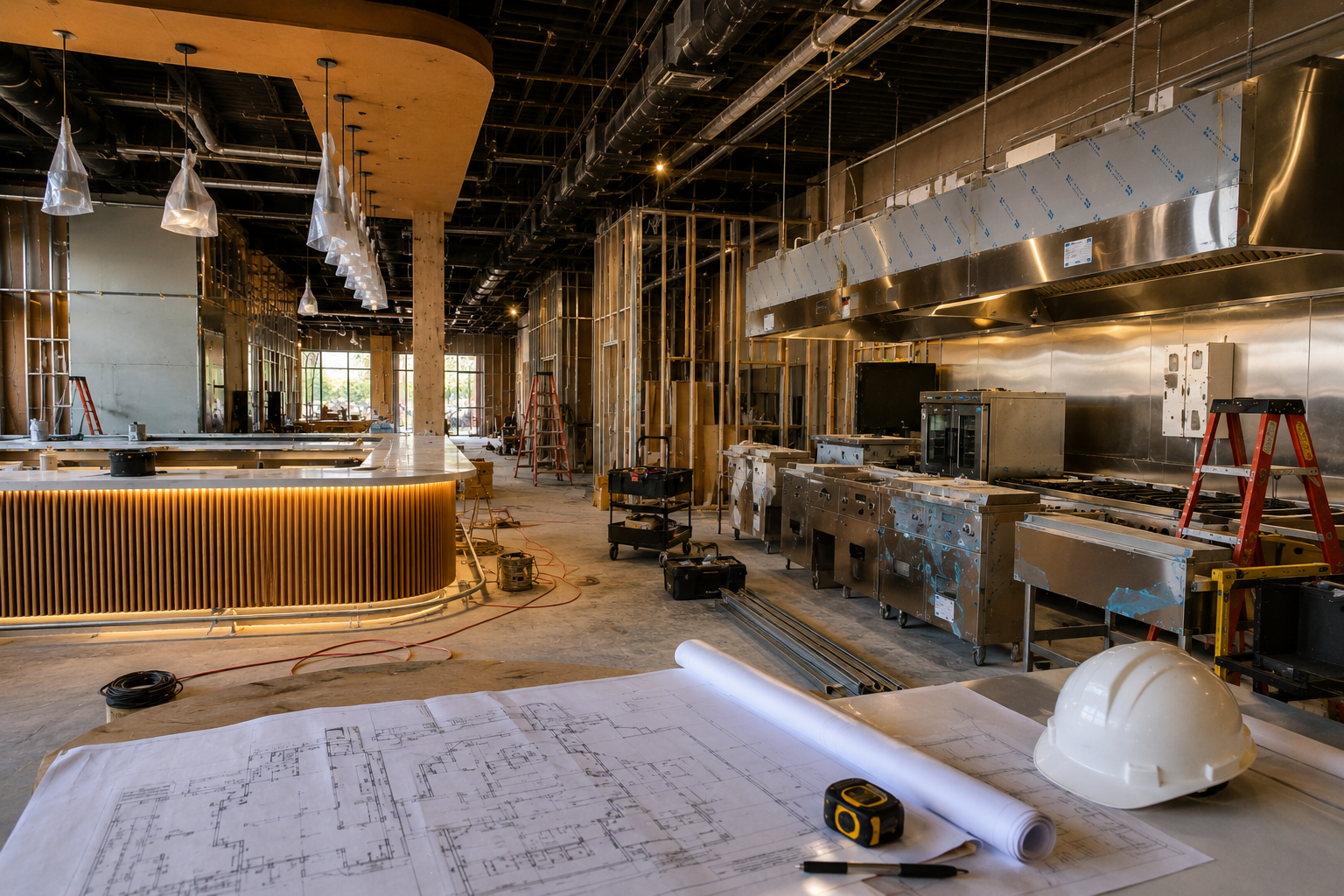
- Vanilla shell - Bare walls, little or no restaurant infrastructure, and sometimes not even finished restrooms. The rent may look attractive, but nearly everything has to be built.
- Second-generation restaurant space - A prior tenant already operated food service in the space. Hoods, grease systems, plumbing, electrical capacity, coolers, or equipment may already be there. If the infrastructure fits your concept, the savings can be substantial.
- Turnkey - The space may be close to ready, but you are often paying for that convenience through rent, key money, an equipment package, or a layout you would not have chosen yourself.
We steer a lot of first-time operators toward second-generation restaurant space for a reason. It is not always the prettiest option on day one, and you may inherit a few compromises. But avoiding a new hood, major grease work, or a full electrical upgrade can preserve six figures of capital for the things guests will notice - and for the cash cushion you will need after opening.
The build-out budget, broken down
These are broad planning ranges for early planning, not bids. Market, concept, finish level, code requirements, and the condition of the existing space can move them considerably.
- Kitchen equipment - $75,000-$300,000+ depending on menu complexity and whether you buy new, used, or reconditioned equipment
- HVAC, hood, and fire suppression - $40,000-$150,000, with more exposure when a hood system is being added from scratch
- Plumbing and grease management - $20,000-$80,000
- Electrical - $25,000-$100,000, especially sensitive to heavy kitchen equipment and a large bar program
- Flooring, walls, and ceilings - $30,000-$120,000
- Furniture, fixtures, and equipment (FF&E) - $50,000-$200,000 depending heavily on design ambition
- Bar build-out - $40,000-$150,000 for a meaningful beverage program
- Signage and exterior work - $10,000-$50,000
- Architecture, engineering, and permitting - Often modeled at roughly 8-12% of construction cost
For a mid-size full-service restaurant in second-generation space, those categories can put the project in the $400,000-$1,000,000 range before the opening inventory, pre-opening payroll, and operating reserve are added. A vanilla-shell or ground-up project can move well beyond that.
The costs that rarely make it onto the contractor bid
This is where otherwise reasonable opening budgets start to get tight.
- Liquor license - From a modest application cost to well over $100,000 in markets where licenses are restricted or transferred privately
- Initial inventory - Food, beverage, disposables, smallwares, uniforms, and opening pars
- POS system and hardware - Terminals, handhelds, printers, networking, and setup
- Pre-opening payroll - Management, training shifts, mock service, and opening-week staffing before revenue normalizes
- Menu development and recipe testing - Including the product used to get the menu ready
- Legal and accounting - Entity setup, lease review, licenses, and professional fees
- Insurance - Deposits and first-year premiums
- Opening marketing - Photography, signage, launch campaigns, events, and initial promotional spend
- Security deposits - Often some combination of first month, last month, and an additional landlord deposit
None of these show up on a contractor's bid. Every one of them shows up on your bank statement.
Then there is working capital
A restaurant can finish construction on budget and still be undercapitalized. The dangerous gap is the period after opening, when payroll is fully real but sales are still finding their normal level. Vendors need to be paid, repairs happen, training continues, and the first few weeks are rarely as efficient as the mature operation you modeled.
Three to six months of operating expenses in reserve is a reasonable rough starting point. Some projects need more, particularly when the opening lands in a slow season or the concept is expected to ramp gradually.
So what is the planning range?
Speaking very generally, these are useful starting bands for early planning:
- Small counter-service or fast-casual concept, second-generation space - $250,000-$600,000 all-in
- Mid-size full-service restaurant, second-generation space - $500,000-$1,200,000 all-in
- Full-service concept with a serious bar program and better finishes - $800,000-$2,000,000+ all-in
- Ground-up build or vanilla shell - Plan for a meaningful premium over comparable second-generation space; the actual gap depends heavily on infrastructure, code requirements, and shell condition
Where a project lands inside those ranges depends on the market, the building, and how disciplined the team is before the lease gets signed. We have seen operators save meaningful money by choosing the right second-generation space and sourcing equipment intelligently. We have also seen a project become unnecessarily expensive because the financial model came after the real estate decision instead of before it.
Get the number while you still have choices
The worst time to discover a project is 30% or 40% more expensive than expected is after the lease is signed and the landlord is waiting on a construction schedule. At that point, most of the good options are gone.
A useful opening model is built from the concept, the space, the menu, the staffing plan, and the capital structure. It gives you the number early enough to change the scope, find a different site, phase the project, or raise more capital before you are committed.