Working capital is what gets you through the ramp-up
A restaurant can be fully built, staffed, stocked and ready to open — and still be undercapitalized. The problem is usually not the opening budget. It is the cash needed after opening, when payroll, food purchases, rent, utilities and marketing are due before sales have settled into a predictable rhythm.
For planning purposes, think of working capital as the cash reserve available to fund normal operations until the restaurant can consistently support itself. It is separate from the money used to build the space, buy equipment and furniture, pay deposits, or complete the pre-opening work.
That distinction matters. Too many restaurant budgets are built to get the doors open, not to carry the business through the first several months.
What belongs in a restaurant working-capital plan?
A useful working-capital plan should account for the cash demands that continue after the construction budget is spent.
- Payroll and payroll taxes, including management salaries
- Food, beverage and operating-supply purchases
- Rent, CAM or other occupancy costs
- Utilities, insurance and recurring software
- Credit-card processing and other transaction costs
- Marketing and opening-period promotional spending
- Repairs, replacements and the inevitable early operational surprises
- A receivables cushion if the business will do catering, events or corporate billing
Initial inventory and pre-opening payroll are sometimes included in the project budget and sometimes treated as working capital. Either approach can work. What matters is that the costs are only counted once and that the cash is actually available when needed.
How much working capital should a restaurant plan for?
Three to six months of operating expenses is a common starting point, but it should not be used as a shortcut. The right number depends on the concept, opening season, rent structure, staffing model, debt service, expected sales ramp and how much flexibility exists if sales come in below plan.
The better method is to build a month-by-month cash-flow model and identify the maximum cumulative cash deficit before the business becomes self-funding.
Step 1: Build the real monthly operating budget
Start with the expenses the restaurant will actually carry at the sales levels you expect during the first year. Do not model a mature restaurant and assume the percentages will behave the same way during the opening months.
- Labor by position and shift, not just a single labor percentage
- Food and beverage cost based on the planned sales mix
- Occupancy costs, including rent, CAM, property pass-throughs and percentage rent if applicable
- Utilities, insurance and recurring technology
- Marketing, repairs, linen, pest control, cleaning and other operating expenses
- Debt service and required owner or investor obligations that affect cash
Step 2: Model the sales ramp conservatively
New restaurants rarely move in a straight line from opening day to steady-state sales. There may be an opening spike, a drop after the initial curiosity, seasonality, staffing limitations or simply a slower build than expected. The model should reflect the specific market and concept rather than a generic industry curve.
- Month 1 — 30–50% of steady state: soft opening, limited awareness, training and operating adjustments
- Month 2 — 50–65%: awareness building; service and menu still being refined
- Month 3 — 60–75%: repeat traffic begins to matter; marketing has more data to work with
- Month 4 — 70–85%: operations should be more stable, but costs may still be elevated
- Months 5–6 — 80–95%: concept approaches a more normal operating rhythm
- Months 7–12 — 90–100%+: seasonality and market conditions become the bigger variables
These percentages are planning examples, not universal benchmarks. A destination restaurant, seasonal market, fast-casual concept and neighborhood bar can have very different ramp-up patterns.
Step 3: Calculate the cumulative cash burn
For each month, subtract cash operating expenses and required financing payments from expected cash receipts. If Month 1 requires $80,000 of cash outflow and produces $35,000 of cash inflow, the Month 1 shortfall is $45,000. Repeat that process month by month and track the cumulative deficit until cash flow turns sustainably positive.
A practical reserve target is the maximum cumulative deficit, plus any pre-opening operating costs not already included elsewhere, plus a contingency. This approach is more useful than simply multiplying one month of expenses by an arbitrary number because it ties the reserve directly to the way the business is expected to perform.
Pre-opening costs are where many plans get thin
Cash can start disappearing well before the first guest arrives. Managers may be on payroll during construction. Hourly staff may need one or two weeks of training. Menu testing consumes product. Rent can start before opening. Utility deposits, licensing, marketing and last-minute smallwares all add up.
- Management payroll during build-out and setup
- Hourly training payroll and staff meals
- Test-kitchen and menu-development product
- Licensing, professional fees and utility deposits
- Pre-opening marketing and opening events
- Rent or carrying costs during delays
- Last-minute equipment, smallwares and replacement purchases
The important budgeting question is not whether these costs are labeled "pre-opening" or "working capital." It is whether the total capital plan has enough cash to absorb them without shrinking the operating reserve.
Five working-capital mistakes that create avoidable pressure
1. Assuming the opening buzz will continue
A strong first weekend can hide a weak capital plan. Base the model on sustainable traffic, not the best nights of the opening period.
2. Raising enough money to open — but not enough to operate
A project can be fully funded on paper and still run short of cash if the capital stack covers construction and equipment but leaves little runway for the first six months.
3. Ignoring seasonality
Opening into a slow season can materially increase the reserve required. The same concept may need a very different capital cushion depending on whether it opens before peak demand or just after it.
4. Treating the construction schedule as fixed
Delays create a double hit: carrying costs continue while the first revenue dollar moves farther away. Build contingency into both the construction budget and the cash-flow timeline.
5. Underpricing the menu to chase traffic
Low prices do not solve an undercapitalization problem. If contribution margins are too thin, the restaurant needs more volume just to cover the same fixed costs — which can increase cash burn rather than reduce it.
Ways restaurant projects typically fund working capital
Working capital can come from several sources, and many projects use a combination.
- Owner equity or partner capital
- Equity investors
- SBA or conventional commercial financing where available
- Business lines of credit for short-term flexibility
- Landlord contributions, tenant-improvement allowances or rent abatement that preserve cash for operations
High-cost short-term financing can be useful in specific situations, but it is a poor substitute for a viable operating model. If the business is using expensive debt to cover a recurring structural loss, the underlying economics need attention.
What investors and lenders should be able to see
A credible restaurant capital plan should make the opening-period cash requirement easy to understand. At minimum, it should show:
- Startup and build-out costs separated from operating reserves
- Monthly profit-and-loss projections for at least the first two years
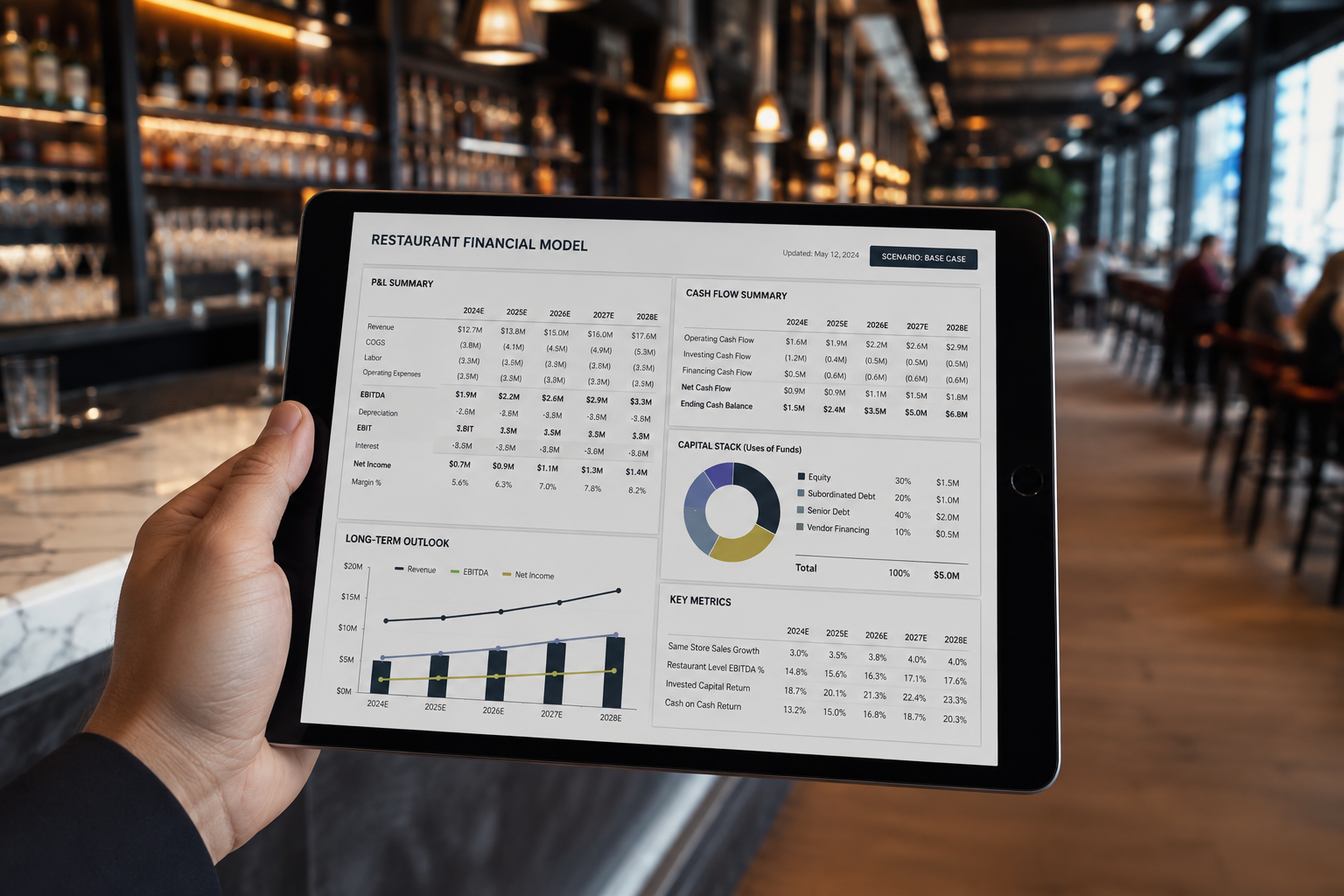
- Monthly cash flow showing the sales ramp and maximum cash draw
- A downside case showing what happens if revenue is slower or costs run higher
- The sources of capital and when each source will be available
The model is not only for the bank or investor. It gives the operator a much earlier warning if the concept, rent, staffing plan or opening budget does not leave enough margin for error.
If you're building a capital plan for a new restaurant, our restaurant financial modeling work connects the concept, operating plan and opening runway into one model — and our case studies show how that's played out for real projects.