Food cost is not the same thing as profit
We have had this conversation more times than we can count: an owner is proud that food cost is running at 26%, but the restaurant is still not making the money it should. Food cost percentage is easy to calculate and easy to compare. That is why people give it more authority than it deserves.
A restaurant does not deposit percentages in the bank. It deposits dollars. A higher-cost entree can leave far more dollars behind to pay rent, labor, utilities, and profit than a lower-cost appetizer with a prettier food-cost percentage. If every item is priced only to hit the same target ratio, the menu can look disciplined on paper while quietly under-earning.
Price for contribution, not a single cost ratio
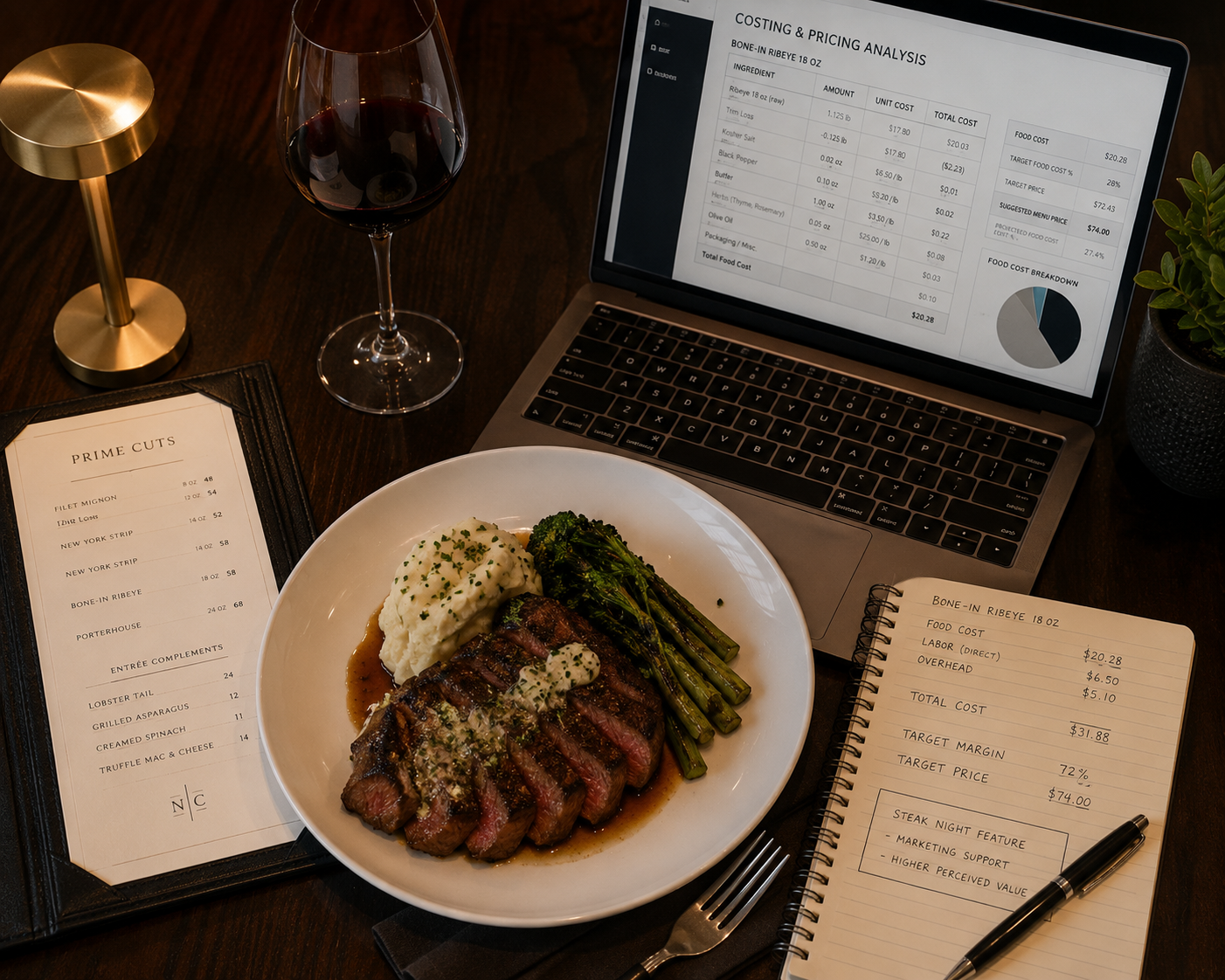
Contribution margin is the money left from an item after its direct product cost. That is the money available to carry the rest of the restaurant. When we look at pricing, we want to know how many dollars the dish contributes and whether those dollars make sense for the labor, prep, ticket time, equipment, and menu space the item consumes.
Two dishes can have the same food-cost percentage and be very different businesses for the kitchen. One may be fast, forgiving, and easy to prep. The other may require a skilled cook, a specialty ingredient, extra mise en place, and five more minutes on the line. The price should recognize that difference.
What belongs in a defensible menu price
- True recipe cost - Every ingredient at the purchase cost and portion size you are really using, including sauces, garnishes, oils, and finishing items
- Yield and waste - Trim loss, spoilage, cooking loss, and the gap between purchase weight and sellable portion
- Labor intensity - Prep time, cook time, plating complexity, and whether the item slows a station during peak volume
- Guest price sensitivity - What your market and your concept can reasonably support for that category
- Menu role - Whether the item is a traffic driver, a signature dish, a high-contribution workhorse, or something that exists mainly to complete a category
Skip one of those inputs and you can end up in either direction: underpriced relative to the work and product involved, or priced beyond what the guest believes the item is worth.
Once you have sales data, the menu gets much more interesting
This is where classic menu engineering becomes useful. We sort items by popularity and contribution, then decide what the restaurant should do with each group.
- Stars - High popularity and high contribution. Protect them, feature them appropriately, and be careful about changing the things guests already love
- Plow horses - High popularity but weaker contribution. Look for a modest price move, portion refinement, purchasing improvement, or recipe adjustment that does not damage the reason the item sells
- Puzzles - Strong contribution but weak popularity. They may need better placement, a clearer description, staff attention, or a hard look at whether the guest understands the value
- Dogs - Low popularity and low contribution. Most should earn a very good reason to stay on the menu
The important part is not memorizing the four boxes. It is what you do after you see the pattern. A menu report that does not lead to a pricing, placement, recipe, purchasing, or deletion decision is just a report.
Use the page to support the economics
Menu design matters, but we prefer to treat the common "menu psychology" rules as things to test rather than laws of nature. Guests behave differently by concept, price point, occasion, and menu format. What matters is that the page makes the dishes you want to sell easy to understand and easy to find.
- Hierarchy - Give the strongest categories and items enough visual weight without turning the menu into a collection of callout boxes
- Anchoring - A premium item can help guests understand the price range of a category, but it still has to belong there
- Descriptions - Specific ingredients, techniques, or provenance can communicate value better than generic adjectives
- Price presentation - Use a clean, consistent format that lets the guest read the menu without making price the only thing that jumps off the page
The goal is not to trick anybody into ordering. It is to make the menu easy to shop while giving the restaurant its best chance to sell the right mix.
Raise prices with a reason and with data
Regulars notice price changes, especially when the increase feels random or lands all at once. That does not mean prices should stay frozen while product, labor, and occupancy costs rise. It means repricing should be deliberate.
- Move where the menu has room - High-demand items may have more pricing power than weak sellers
- Avoid a lazy flat percentage - Different items have different economics and different guest sensitivity
- Use menu changes as a natural reset point - New items, improved recipes, or a refreshed format can make the change feel like a better menu rather than the same menu for more money
- Watch the sales mix afterward - If a price move materially changes what guests order, that is information worth using
The menu is a financial document guests happen to read
A lot of menus are designed first and priced at the end. We prefer the opposite order. Recipe cost, contribution, operational complexity, guest value, and sales strategy should shape the page. The graphic design should then make those decisions easier for the guest to navigate.
If a menu has not been fully costed or re-engineered in a while, the opportunity is usually bigger than raising every price by a dollar. The real work is understanding where the restaurant earns, where it is subsidizing weak items, and what the guest is telling you through the sales mix.